Wednesday, November 18, 2015

Bunions

The Cause of Foot Bunions
A bunion is a deformity involving the big toe.  As the bunion develops you will begin to notice an enlargement on the inner side of the first toe near the metatarsal-phalangeal joint (MTP joint).  The MTP joint is where the big toe joins to the long bone of the foot.
 
As a bunion continues to enlarge you may begin to experience pain, swelling and limited range of motion in the MTP joint.  You may even develop pain due to the rubbing and friction of your bunion on the inside of constricting shoes. 
 
Most patients who suffer from bunions and many doctors who have treated those patients do not understand the actual cause of why the bunion developed in the first place.  Most doctors believe that the bunion was caused by an inward misalignment of the first metatarsal bone (the long bone on the inner side of the foot), combined with a compensatory outward deviation of the large toe.  Although this is a correct observation with a bunion deformity, it is not the true underlying cause of the bunion formation.
 
Bunion
The bunion deformity is merely the result of a more profound problem involving the entire foot structure.  There is a “normal posture” of the foot’s structure, and when that structure is maintained a bunion will not develop.

 
There are 26 bones in the foot.  Those bones all have a normal, healthy alignment that they are supposed to be in.  The primary misalignment or foot dysfunction leading up to a bunion formation develops in the hind-foot.  The hind-foot consists of two primary bones, the heel and ankle bones.  When the heel and ankle lose their healthy alignment, it causes a domino effect of misalignments into the mid-foot and fore-foot.
 
A common proposed solution for bunions in the medical world is to break the first metatarsal bone and bend it into a straightened position. The problem with this procedure is that it does nothing to improve the actual underlying biomechanical problem that caused the bunion.
 
 A better solution is to work with the entire foot to diagnose and correct the alignment of the heel and ankle and then the mid-foot and fore-foot.
 
In addition to adjusting the spine, we also work on correcting misalignments of the feet.  We do this through gentle adjustments to the foot bones.
 
Our foot patients love having their feet adjusted.  Since your feet are the foundation, having them adjusted and aligned properly will benefit your entire body.
 
 ***Disclaimer: This content is solely for informational purposes and should not be substituted for medical or chiropractic advice. It is recommended that you seek professional advice by a licensed health care professional.


Scott Chiropractic and Wellness
Matthew Scott, DC 
5080 Virginia Pkwy Ste 550
McKinney, TX 75071
972-540-5445


Monday, November 9, 2015

5 Simple Ways to Improve your Health with Gratitude


Autumn

We wish you and your family a Happy Thanksgiving season!  You will find valuable health tips in every month’s issue of our Full Body Chiropractic Newsletter.
 
We strive to provide the latest and best health information to help you meet your goals and have the well-being you deserve.  Please continue to share your testimonials, as many of you have been experiencing wonderful results with chiropractic care at our clinic.


5 Simple Ways to Improve Your Health with Gratitude

Dr. Robert A. Emmons described research he carried out with three experimental groups over 10 weeks (Emmons & McCullough, 2003):  People who expressed daily gratitude felt 25% happier. They were more optimistic about the future, they felt better about their lives, and they even exercised 1.5 hours longer per week on average.
 
Here are 5 simple ways to improve your health with gratitude.
 
1.  Keep a gratitude journal.
 
Take time first thing in the morning or last thing in the evening to write three to five things about what you are thankful for.  Keep a notebook, journal, or loose paper and a pen on your nightstand for convenience.  Reflect on the good, pure and lovely highlights of your day and transcribe them onto paper.  You will feel better and have a deeper sense of appreciation.
 
2.  Speak positively to yourself.
 
Learn to tame your “inner chatter” with only words of encouragement, edification and confidence.  Transform any self-doubt, negativity and words of disapproval such as,
Thank You

“I am not good enough or worthy” to words like “I am worth it, I am valuable, I deserve to have the best in my life.” 
 
Speaking and thinking positivity over yourself will improve your self esteem and cause you to feel better and happier about yourself.
 
3.  Surround yourself with optimists.
 
Find people that are grateful and spend quality time with them.  Chances are you are like those that you hang around with most.  This is true with attitudes.  Make sure that the people you spend the most time with are uplifting and live life in a positive light instead of an ungrateful manner.  Other people’s gratitude and positivity will rub off on you and as a result you will become a happier and healthier person.
 
4.  Listen to and read uplifting material.
 
Spend leisure time indulging in edifying material.  Books and audios that build up the inner man and make you feel good about yourself and life.  Tony Robbins, Bob Proctor, Joyce Meyer and other wonderful authors have wonderful material to encourage, motivate and promote proper thinking.
 
5.  Take time to say thank you.
 
One of the best ways to remain thankful is to tell others you appreciate them and how much they mean to you.  A simple handwritten note is a nice touch and means a lot to the one receiving it.  Picking up the phone to call someone and say “thank you” goes a long way and will cause you to feel good in the process.  As you engage in making other’s feel appreciated you will in turn reap great rewards with your own happiness and emotional health.
 

 ***Disclaimer: This content is solely for informational purposes and should not be substituted for medical or chiropractic advice. It is recommended that you seek professional advice by a licensed health care professional.


Scott Chiropractic and Wellness
Matthew Scott, DC 
5080 Virginia Pkwy Ste 550
McKinney, TX 75071
972-540-5445


Monday, October 26, 2015

A Complete Wellness Approach

A complete wellness approach is a comprehensive focus on adopting positive habits that will increase the well-being of your physical, mental, social, and spiritual self.  Quality chiropractic care is an essential aspect of your wellness plan.  Maintaining your nervous system is essential to balance other areas of your wellness plan.

Wellness plans include regular checkups with your physician and dentist, so why not your chiropractor? Chiropractic care is more than fixing bad backs and alleviating pain. Regular chiropractic care gives the patient energy and increased endurance.


People maintain their teeth and their car, but forget about their nervous system. There is a common misconception that the absence of pain means that the body is healthy. Wellness is more concerned with a higher level of thinking that requires that the patient be at their mental and physical best to get the most out of life.  Again, the nervous system brings your body up to this level through regular chiropractic care. For those who seek to live their best life through a comprehensive wellness plan, regular chiropractic care is an essential element.  


Chiropractic treatment enables your body to benefit from the rest of your wellness routine. If you are exercising regularly, chiropractic treatment enables you to do so without added pain and stiffness. If you are eating well, regular chiropractic treatments aid in a regular digestion system. Chiropractic has the ability to bring together all aspects of a wellness program so you can reap the maximum benefits from your healthy lifestyle. The result is more vitality, greater endurance, and the ability to be the best in all that you do.
 
 
 ***Disclaimer: This content is solely for informational purposes and should not be substituted for medical or chiropractic advice. It is recommended that you seek professional advice by a licensed health care professional.


Scott Chiropractic and Wellness
Matthew Scott, DC 
5080 Virginia Pkwy Ste 550
McKinney, TX 75071
972-540-5445


Tuesday, October 20, 2015

Thumb Arthritis

A Solution for Thumb Arthritis
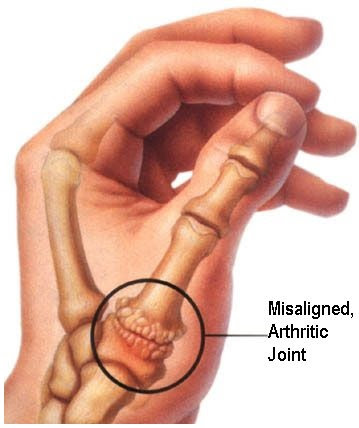
There is a tiny bone in the carpal (wrist) area known as the trapezium.  The trapezium is directly above the first metacarpal (the long bone for the thumb), where the thumb connects to the wrist.  This joint is known as a “saddle joint” because it has a unique shape similar to a horse’s saddle.  The saddle shape provides this joint a much greater range of motion compared to the other thumb and finger joints.  It is at this joint where thumb arthritis occurs.
 
Arthritis
This thumb joint is the most common joint in the entire body to become arthritic in the greatest number of people.

 
Because there is such broad motion at this “saddle joint”, it gets the heaviest workout.  We use our thumbs to grip and hold most objects, and the thumb is always opposing the four fingers.
 
The fingers oppose the thumb four against one.
 
After a period of time the thumb may lose its healthy alignment where it connects to the carpal region.  This misalignment will irritate the joint and cause the cartilage surfaces to become worn.  This wearing of the cartilage is referred to as degenerative joint disease or osteoarthritis.
 
It is a common misconception that arthritis cannot be treated through chiropractic.  Practically every patient we treat has some form of arthritis.  If you break the word down to its root meaning, arthritis means “joint inflammation”.  When two bones become misaligned relative to each other, the joint at which they connect becomes irritated and inflamed.
 
Adjusting the small wrist and hand bones will restore healthy alignment and function to the irritated joints.  In addition to pain relief patients often experience increased strength, range of motion and greater ability to grip objects for longer periods of time without pain and fatigue.
 
Arthritic pain and dysfunction can be helped with chiropractic care.  If you or someone you know is dealing with arthritic pain, we recommend a chiropractic evaluation to determine if there is a solution that can provide relief and restore healthy function to their hand.
 
 ***Disclaimer: This content is solely for informational purposes and should not be substituted for medical or chiropractic advice. It is recommended that you seek professional advice by a licensed health care professional.


Scott Chiropractic and Wellness
Matthew Scott, DC 
5080 Virginia Pkwy Ste 550
McKinney, TX 75071
972-540-5445

Tuesday, October 6, 2015

Three Important Fall Health Tips


Autumn

As cooler weather begins to set in it is vitally important to focus on better health and a stronger immune system.  We’ve included three important health tips that your family will benefit from this time of year.
 
It’s also the time of year when more patients start to experience thumb pain and symptoms related to thumb arthritis and/or overuse.  You will be pleased to know that you don’t have to learn to live with a painful thumb.  This month’s article on solutions for thumb arthritis will provide you the education you need to make an informed decision, for improving the health of your hands. 
 
Enjoy the seasonal changes we’re about to experience, and thank you for sharing our Full Body Chiropractic Newsletter with your friends.


Three Important Autumn Health Tips

 
Heading into the cooler months there are three very important health tips that come to mind.  If you follow these three tips your chances of an enjoyable fall season will increase substantially.  Here are those three health tips:
 
1. Trade sweets for healthy snacks:  Studies show that one teaspoon of sugar will reduce your immune system’s function for up to six hours.  Those sodas and sugary snacks will provide you with short-term bliss; however they will also hamper your body’s ability to ward off contracting the cold or flu. 
 
If cutting out all sweets seems to be too much of a challenge, you should consider reducing your intake by one-half.  So if you’re used to two sodas, two cookies and a handful of chocolates, you may want to trade a bottle of soda for a glass of water, a cookie for an apple and a few chocolates for some veggies with dip.
 
Although it may not be easy at first, the noticeable health benefits you gain will certainly make up for the sacrifice.
 
Autumn Health Tips
2. Stretch before activities:  Cold weather can do serious damage to your joints, ligaments and tendons.  Where you might be able to get away with a brisk morning run during the warmer months without stretching, it can cause much havoc to your body if you don’t warm up during cooler months.
 
Your stretching routine doesn’t have to be a long, drawn out process.  Even five minutes of pre activity stretching can make a world of difference. If you’re simply going for a jog you may be fine with stretching your calves, hamstrings and quadriceps.  On the other hand if you’re going to play tennis or some other racquet sport you may also want to include upper body stretches for your shoulders and arms.
 
Also keep in mind that it is just as important, if not more important, to stretch your muscles after your workout as a cool-down technique.
 
3. Receive your chiropractic wellness adjustment:  The testimonials we receive from our patients speak loud and clear the health benefits of getting a regular chiropractic checkup.          
 
Many of our patients bring their entire family in for a routine chiropractic adjustment.  They do this because they have found that having a periodic wellness adjustment will keep their spines and other body areas “fine-tuned” and functioning at its optimal potential.
 
Periodic chiropractic wellness adjustments will also help reduce your family’s medical expense.  Good alignment promotes a healthy nervous system, allowing your body to consistently function at its peak performance, thus helping to prevent a major breakdown in health.
 
 ***Disclaimer: This content is solely for informational purposes and should not be substituted for medical or chiropractic advice. It is recommended that you seek professional advice by a licensed health care professional.

Scott Chiropractic and Wellness
Matthew Scott, DC 
5080 Virginia Pkwy Ste 550
McKinney, TX 75071
972-540-5445

Monday, September 14, 2015

Heel Spurs and Heel Pain

Heel Spurs & Morning Heel Pain
Some people experience sharp, stabbing foot pain immediately upon awakening and getting out of bed.  Heel pain first thing in the morning is a sign that you may have a heel spur.
 
The morning foot pain associated with a heel spur normally lasts about 10 minutes or less before it begins to calm down; however the pain pattern may become worse over time until it eventually becomes constant.
 
Each foot has 26 movable tarsal bones which are arranged into a network of arches.  However when you lose the healthy alignment of one or more of those bones you may begin to develop foot pain.
 
Two of the most common foot conditions that develop as a result of misalignments are plantar fasciitis and heel spurs.

Plantar Fasciitis
Plantar fasciitis is a condition in which the soft tissues on the bottom of the foot (the plantar fascia) become overstretched, irritated and inflamed.  The classic symptoms associated with plantar fasciitis include pain on the bottom of the heel and sometimes into the arch of the foot.

 
Attaching from the heel to the five toes, the plantar fascia spans the entire plantar surface of the foot.  Due to misalignments of the tarsal bones and altered foot function, this tissue becomes overstretched and develops micro-tears near its attachment at the heel bone.
 
If the tarsal bones aren’t realigned in a timely fashion, the foot will begin to develop a bony heel spur near the attachment site of the plantar fascia.
 
It’s important to note that a heel spur does not cause pain by itself.  Rather it’s the irritation, micro-tearing and inflammation of the connecting plantar fascia that results in heel pain.
 
As plantar fasciitis remains untreated and is allowed to progress into a chronic condition, a heel spur may develop and continue to become larger and more prominent over time. Common symptoms associated with plantar fasciitis accompanied by a heel spur, includes morning heel pain first thing upon standing up.   
Specific chiropractic adjustments to the foot bones will correct the underlying mechanical problem, improve foot function and ease tissue stress.  Getting your feet adjusted is an effective, non-surgical solution for alleviating the pain associated with plantar fasciitis and heel spurs.
 
***Disclaimer: This content is solely for informational purposes and should not be substituted for medical or chiropractic advice. It is recommended that you seek professional advice by a licensed health care professional.

Scott Chiropractic and Wellness
Matthew Scott, DC 
5080 Virginia Pkwy Ste 550
McKinney, TX 75071
972-540-5445www.scott-chiropractic.com

Wednesday, September 9, 2015

Can Chiropractic Help Broken Bones?
People who have suffered an injury in which they fractured a bone, will often say something such as, “I broke my wrist so chiropractic can’t help me.”  However in actuality the exact opposite is often the case.
 
While it’s true that chiropractors don’t adjust fractures, it is vitally important to have the nearby joints checked for misalignments.  If a trauma was significant enough to break a bone, that means there was more than enough force to cause misalignments at its neighboring joints.
 
Forearm Fracture
For example, let’s assume that you fell and used your hand to brace your fall, and as a result you broke your forearm.  In addition to the fractured forearm, you will also likely have suffered a misalignment at the wrist, elbow and possibly even the shoulder.

 
Of course the immediate treatment should be to stabilize the fracture and have it casted or braced appropriately by a medical expert; however, as soon as the healing process permits you should have the wrist, elbow and shoulder joints checked for misalignments.  It’s even possible that such a fall could cause injury or misalignments in spine as well.
 
It’s interesting that many patients will normally seek chiropractic care immediately following an injury that didn’t involve a broken bone, but wait several months before getting adjusted if the injury involved a fracture.
 
You should rest assured that it is completely safe to be checked and adjusted shortly after having suffered a fracture.  While we may not be able to adjust the actual bone that broke if that fracture hasn’t yet fused, but we would most likely be able to address the adjacent areas.
 
Every case is unique as to whether or not we would be able to adjust the area adjacent to the fractured bone.  In the unfortunate event of an injury that results in a fracture, we recommend that you schedule to have an examination here at this clinic to rule out potential misalignment problems, and to determine your options in having those misalignments corrected.
 
***Disclaimer: This content is solely for informational purposes and should not be substituted for medical or chiropractic advice. It is recommended that you seek professional advice by a licensed health care professional.

Scott Chiropractic and Wellness
Matthew Scott, DC 
5080 Virginia Pkwy Ste 550
McKinney, TX 75071
972-540-5445
www.scott-chiropractic.com