Showing posts with label Wrist Pain. Show all posts

Thursday, April 14, 2016

Texting and Hand Pain

Avoid Hand Pain Related to Texting 

Did you know that one of the common causes of hand pain is related to texting with your handheld PDA device?

There are three main factors that can increase your chances of developing a painful hand condition from using your phone to send messages.  We will discuss those factors as well as what you can do to greatly reduce the stress on your hands while messaging others or surfing the web.
    1. Prolonged Texting:  One of the greatest factors as to why you may suffer a texting related hand injury is the length of time you spend texting at once.  Typing on your smartphone for more than 10-15 fifteen minutes can begin to fatigue the tiny hand muscles and begin to cause stress on the thumb joints. 

    Sending several texts over the course of one hour is less stressful on your hand than sending those    same texts within a ten minute period.  What’s more traumatic on your hand is if you engage in mass texting for short periods several times each day.  
     Texting
    2. Single Handed Texting:  Holding your smartphone in one hand while using that same thumb to type will potentially lead to overuse of your thumb joint where it connects to the wrist.  The thumb has a broader range of motion and is therefore more versatile than the fingers.  This gives the thumb the natural ability to type away on the touch display of your phone. 

    The challenge with this is that your thumb will often encounter stressed motions and positions as the movements are not natural.  You’ll be inclined to stretch your thumb outward or move it into compromising positions as you employ single handed texting.  A better solution is to hold your smartphone using both hands, while one or both thumbs participate in the typing process.  This will alleviate much of the stress and strain on your thumb joints.

    3. Size of Phone or Handheld Device:  The smartphone options made available in the marketplace seem to get a little larger each year.  From a hand health standpoint, bigger isn’t always better when it comes to the phone you choose.

    With larger phones your thumb will be forced to stretch farther across the display, causing a greater amount of physical stress to your hand.  This is especially so with single handed use as described above.  When using a larger device, you definitely should consider using both hands when texting, messaging or surfing the web.

    Optimal thumb function while texting requires healthy alignment of the wrist and hand bones and joints.  When these bones and joints are aligned properly the connecting muscles and tendons will function harmoniously to provide proper thumb movement.

    Chiropractic adjustments to the wrist and hand can alleviate the stress and dysfunction associated with thumb and other wrist/hand musculoskeletal conditions.

    ****Disclaimer: This content is solely for informational purposes and should not be substituted for medical or chiropractic advice. It is recommended that you seek professional advice by a licensed health care professional.


    Scott Chiropractic and Wellness
    Matthew Scott, DC
    5080 Virginia Pkwy Ste 550
    McKinney, TX 75071
    (972) 540-5445

    Monday, January 18, 2016

    Carpal Tunnel Syndrome

    The Truth about Carpal Tunnel Syndrome 

    Carpal tunnel syndrome is a painful and debilitating hand condition.  Sadly, it affects many people who use their hands repetitively or strenuously.

    Do you have pain, tingling, numbness or burning sensations in your thumb and first three fingers?  Do you ever lose your ability to grip, pick things up, or control hand motions that require fine detail?  Carpal tunnel syndrome can cost people their jobs, hobbies, peace of mind and quality of daily living, not to mention hundreds and even thousands of dollars in lost wages.

    CTSIf you have been diagnosed with CTS or suffer from one or more of those hand symptoms, please call our office to get checked out.

    The carpal tunnel is a narrow passageway located within the wrist. There are 8 tiny bones in the wrist arranged in a curved, horseshoe shape. Those 8 bones form 3 sides of the carpal tunnel and the 4th side is from the transverse carpal ligament that overlaps the tunnel. There is a large nerve (the median nerve) that runs through the tunnel. There are also 9 tendons that pass through the carpal tunnel. Due to repetitive movements these tiny carpal (wrist) bones can lose their healthy alignment causing them to collapse inward, pressing on the median nerve. As a result the median nerve becomes flattened and pinched leading to the symptoms of carpal tunnel syndrome.

    One of the most popular ways to treat CTS is to have surgery. The surgeon will cut the ligament in an attempt to provide space for the median nerve and to relieve pressure. Unfortunately by cutting the ligament, the shape of the tunnel loses its healthy integrity as it flattens out slightly. This will often lead to wrist instability.

    Patients may experience short-term relief following surgery, but over time their carpal tunnel can develop scar tissue from the surgery, and as a result they may encounter a return of symptoms in many cases. In fact post-surgical symptoms can be more severe than before having the surgery.

    The most effective way to treat carpal tunnel syndrome is through specific gentle adjustments to the misaligned carpal bones. As opposed to being a painful process most patients report the adjustment as a pleasant experience. Unlike with surgery, there is absolutely no scar tissue related to this gentle carpal adjusting process.

    Because of our unique focus on treating wrist and hand conditions we have helped many patients who suffered from conditions such as carpal tunnel syndrome.


    Disclaimer: This content is solely for informational purposes and should not be substituted for medical or chiropractic advice. It is recommended that you seek professional advice by a licensed health care professional.


    Scott Chiropractic and Wellness
    Matthew Scott, DC
    5080 Virginia Pkwy Ste 550
    McKinney, TX 75071
    (972) 540-5445

    Tuesday, October 20, 2015

    Thumb Arthritis

    A Solution for Thumb Arthritis
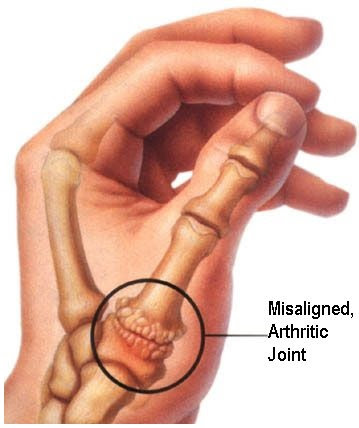
    There is a tiny bone in the carpal (wrist) area known as the trapezium.  The trapezium is directly above the first metacarpal (the long bone for the thumb), where the thumb connects to the wrist.  This joint is known as a “saddle joint” because it has a unique shape similar to a horse’s saddle.  The saddle shape provides this joint a much greater range of motion compared to the other thumb and finger joints.  It is at this joint where thumb arthritis occurs.
     
    Arthritis
    This thumb joint is the most common joint in the entire body to become arthritic in the greatest number of people.

     
    Because there is such broad motion at this “saddle joint”, it gets the heaviest workout.  We use our thumbs to grip and hold most objects, and the thumb is always opposing the four fingers.
     
    The fingers oppose the thumb four against one.
     
    After a period of time the thumb may lose its healthy alignment where it connects to the carpal region.  This misalignment will irritate the joint and cause the cartilage surfaces to become worn.  This wearing of the cartilage is referred to as degenerative joint disease or osteoarthritis.
     
    It is a common misconception that arthritis cannot be treated through chiropractic.  Practically every patient we treat has some form of arthritis.  If you break the word down to its root meaning, arthritis means “joint inflammation”.  When two bones become misaligned relative to each other, the joint at which they connect becomes irritated and inflamed.
     
    Adjusting the small wrist and hand bones will restore healthy alignment and function to the irritated joints.  In addition to pain relief patients often experience increased strength, range of motion and greater ability to grip objects for longer periods of time without pain and fatigue.
     
    Arthritic pain and dysfunction can be helped with chiropractic care.  If you or someone you know is dealing with arthritic pain, we recommend a chiropractic evaluation to determine if there is a solution that can provide relief and restore healthy function to their hand.
     
     ***Disclaimer: This content is solely for informational purposes and should not be substituted for medical or chiropractic advice. It is recommended that you seek professional advice by a licensed health care professional.


    Scott Chiropractic and Wellness
    Matthew Scott, DC 
    5080 Virginia Pkwy Ste 550
    McKinney, TX 75071
    972-540-5445

    Tuesday, August 11, 2015

    Self Massage Technique for Hand Pain

    Easy Self-Massage to Alleviate Hand Discomfort
    If you experience stress or fatigue in your hands it wouldn’t be uncommon for most to deem it unnecessary to call in for a checkup, however it could be an indicator of an underlying hand problem. 
     
    In the meantime I’d like to give you a simple self-relaxation technique you can use to relieve your hand tightness and fatigue.  Keep in mind however these relaxation techniques will not correct the underlying problem, rather it will merely provide short-term relief to help you better cope with hand symptoms.
     
    To apply this self-massage technique you will use one hand to massage the other.  To avoid any confusion I will guide you through this simple technique for massaging the right hand.  You may do this on yourself as you read the instructions using your left hand to massage your right hand.
     
    There are two major areas of the palm that we will focus on:Hand Massage Technique


    1. The fleshy muscle pad on the thumb side of your hand (aka thenar pad)
    2. The fleshy muscle pad on the pinky finger side of your hand (aka hypothenar pad)
    There are several small muscles that make up these two prominent muscle pads on the palm surface of your hand.  Massaging these two fleshy pads periodically throughout the day can help keep your hand relaxed and functioning as you continue to work. 
     
    You should use the thumb of your left hand to gently stroke the thenar pad on your right hand.  One of the best methods to work this muscle group is to stroke from the crease at the central portion of your hand (known as the palmar crease) outward toward your thumb.
     
    Massage the thenar pad area for approximately 30-60 seconds and then take a short break. 
     
    Now you should perform a very similar process to the hypothenar pad on the pinky side of your right hand.  Again you should work the muscle group by starting near the palmar crease and stroking outward toward the edge of your hand.  You may also massage by starting near the wrist and stroking outward toward the pinky finger.
     
    Keep in mind that these massage techniques are not supposed to cause pain.  They also are not meant to diagnose or treat any hand condition you may have.  These gentle massage techniques are merely to help you temporarily relax your stressed and fatigued hands.
     
    Again if you have been suffering with hand symptoms (even mild symptoms) we highly recommend that you schedule for a hand evaluation at our clinic.
     
    ***Disclaimer: This content is solely for informational purposes and should not be substituted for medical or chiropractic advice. It is recommended that you seek professional advice by a licensed health care professional.

    Scott Chiropractic and Wellness
    Matthew Scott, DC 
    5080 Virginia Pkwy Ste 550
    McKinney, TX 75071

    Monday, June 29, 2015

    Texting Your Way to Arthritis

    Texting Your Way to Arthritis
    Maybe you’ve heard the term “blackberry” thumb before and wondered if that condition really existed.  There are several other condition names that have been thrown around loosely such as iPhone thumb, cell phone thumb, etc., but all of them are modern, common names for a condition known as De Quervain’s tendonitis.
     
    When De Quervain’s tendonitis isn’t treated appropriately or if treatment is delayed, it may lead to the development of osteoarthritis in the joint where the thumb connects to the wrist.  It is therefore best to seek treatment for this potentially disabling hand condition sooner rather than later.
     
    De Quervain’s tendonitis has been around for a long time and doctors have tried many different things in attempt to treat this painful condition.  Common treatments for De Quervain’s include anti-inflammatory prescription medications, cortisone injections and even surgery in extreme cases.
     
    Texting-Thumb PainHowever there’s actually a non-surgical treatment that will not only alleviate the symptoms associated with De Quervain’s tendonitis, but also correct the underlying problem that caused the condition to develop in the first place.
     
    De Quervain’s tendonitis is a painful condition that affects a couple of the most prominent tendons that control the movements of the thumb.  These tendons glide through a pulley system (or sheath) as they pass through the wrist before connecting to the thumb bone.
     
    Healthy thumb movement and action requires healthy alignment of the thumb joints and wrist (carpal) bones.  When these bones and joints are aligned properly the connecting muscles and tendons will function harmoniously to provide proper thumb movement.
     
    With healthy thumb and carpal bone alignment you should be able to use your cell phone or PDA device to send text messages without any pain or discomfort.  However when you lose the healthy alignment of these bones and joints, with repetitive activities such as texting and playing games on your cell phone or other device, you may begin to develop stress in the interconnecting tendons and joints.  This continued stress may lead to De Quervain’s tendonitis.
     
    Once you understand the relationship between healthy thumb and carpal bone/joint alignment, it becomes apparent why chiropractic adjustments to the wrist and hand can alleviate the stress and dysfunction associated with De Quervian’s tendonitis and other hand conditions.
     
    If you suffer with pain in your wrist or thumb, whether it’s related to texting, gaming or other repetitive activities, we highly recommend that you schedule an appointment with us to have your wrist and hand adjusted.
     
    ***Disclaimer: This content is solely for informational purposes and should not be substituted for medical or chiropractic advice. It is recommended that you seek professional advice by a licensed health care professional.

    Scott Chiropractic and Wellness
    Matthew Scott, DC 
    5080 Virginia Pkwy Ste 550
    McKinney, TX 75070
    (972) 540-5445
    www.scott-chiropractic.com

    Monday, June 1, 2015

    Why New Mothers Develop Wrist Pain

    Why New Mothers Develop Wrist Pain
    Have you ever held a newborn baby and cradled its little body in your arms as you held them snugly to your body?  A new mother may do this for several hours every day.
     
    Cradling a baby can be hard work if you do it the wrong way.  That means there is a “right way” and a “wrong way” to hold a baby.  Mothers who hold their babies the incorrect way are likely to develop “mother’s wrist”.  Mother’s wrist is a common name associated with a wrist condition otherwise known as De Quervain’s Syndrome.
     
    This condition causes significant pain or discomfort on the thumb side of the hand near the wrist.  Some mothers may even develop a small cyst (ganglion cyst) in that same area.
     
    The mistake that most mothers make is that they cradle their little one in their arms without paying any attention to how their hands and wrists are positioned.  The most common problem is that the mother’s wrist is bent sideways or in a flexed position.  This position alone isn’t what causes the problem, rather it’s the incorrect position coupled with the baby’s weight for a sustained period of time.
    Mommy's Wrist


    Holding a baby with your wrist bent can lead to repetitive strain injuries to the hand, wrist and forearm.  It’s not difficult to change your posture to keep the wrists and hands more relaxed and protected.  You do this by maintaining your wrists in a straight, more neutral position while you cradle your baby.
     
    Holding your hands in an awkward, bent position for long periods of time will commonly lead to misalignments of the tiny wrist bones (carpal bones).  De Quervain’s Syndrome or “mother’s wrist” is often associated with misalignments of one or more of the bones in the hand or wrist.
       
    Gentle chiropractic adjustments to the wrist, hand and possibly even the forearm will correct the underlying biomechanical cause of De Quervain’s Syndrome and other wrist ailments that mothers often suffer from.
     
    If you know someone who is dealing with hand or wrist problems please tell them about our practice.  We are making a huge difference in the health of many patients’ hands through gentle chiropractic wrist and hand adjustments. We thank you for helping us spread the word about our hand and foot expertise.
     
    ***Disclaimer: This content is solely for informational purposes and should not be substituted for medical or chiropractic advice. It is recommended that you seek professional advice by a licensed health care professional.
    Scott Chiropractic and Wellness
    Matthew Scott, DC 
    5080 Virginia Pkwy Ste 550
    McKinney, TX 75070
    (972) 540-5445